The time has come


"The time has come," the Walrus said,
"To talk of many things:
Of shoes—and ships—and sealing-wax—
Of cabbages—and kings—
And why the sea is boiling hot—
And whether pigs have wings."

—
Through the Looking-Glass

Saturday, 10 August 2013

Some Less Objectionable Things We Ate …


Well, after the indignant comments we got about eating guinea pigs, this is to show that we also eat and drink non-controversial things.

Today I went to the local market with an Aussie sister who has been visiting our congregation for the last 4 months or so. She hadn’t really had a good look at this particular market, so we wandered around most of it.

Amongst all the fruit and veg etc for sale, you can also buy the ingredients for a rather lovely hot pink tea that they drink here in Ecuador, called “Horchata”. Hollie had tried the dried version of it (you can buy it in tea bags at the supermarkets, and also dried in a packet), but when she saw the fresh version of it, she cried, “how pretty”, and decided that we should buy some and make fresh Horchata. It’s made up of flowers and various herbs, such as carnations, basil, mint, lemon verbena, horsetail, chamomile and other things, and costs 50 cents for a bunch that would make around 10-20 litres of tea.

1-IMGP0485

Horchata tea bags

1-IMGP0480

It is pretty, isn’t it?

You have to wash it thoroughly, then add it to a pot of boiling water for a couple of minutes, then lift out all the bits that look like plants and strain the liquid. Add sugar to taste, and lemon juice. Yum!  How can you go wrong with a hot, sweet, pink drink?

1-IMGP0481

Hollie making tea

1-IMGP0482

The horchata ingredients after being boiled

1-IMGP0483

The finished product

(you can get a stronger pink colour by adding more horse-tail.  The lemon most commonly used here in Ecuador is green, not yellow, as seen above)

We also bought some funny pink-speckled things that look like a cross between a mutant bean and a weird potato. They are actually a variety of potato, but unfortunately taste rather like dirt. Even when boiled then fried with some thyme and garlic, they still had a somewhat earthy flavour.  (In the top right hand corner of the second photo, you can just about see them.  They are in a clear plastic bag.  They cost 25 cents.  Dirt cheap.)

Then to top it all off, we made pan de yucca, or yucca (arrowroot) bread. You can buy pan de yucca here at little shops that also sell yoghurt smoothies (yum!). We found a recipe on the internet and decided to give it a go. The results were not as good as the ones we had bought, but we shall tweak the recipe for next time, and hopefully with practice, we’ll get something pretty yummy.

1-IMGP0484

The pan de yucca should be nice and smooth, like little balls

Recently, we were with an Ecuadorian sister from our congregation, and we were talking about various foods one would or would not eat, such as tripe, goat, intestines, guinea pig (all eaten here in Ecuador), and she either had eaten them or was willing to try them. Then we got talking about Australian animals and how cute some of them were, and Brendan showed her a picture of an echidna. Did our sweet, gentle Ecuadorian sister ask, “can I pat it?” or “can I have one for a pet?” No, the first question out of her mouth was, “can I eat it?!”

Saturday, 27 July 2013

We Eat Cuy (Guinea Pig)


Today we ate cuy for the first time; mainly so we could say we had tried it, not because we thought we might like it. After all, we’ve been here for more than a year, so one has to try it at some stage.

The grandmother of an Ecuadorian sister in the congregation raises guinea pigs, so we organised to go to her place and her grandmother killed, prepared and cooked them for us. There are different ways to cook them, and we were told that grilling them on a barbeque is the best (it makes the skin crunchy – some say that is the best bit). Although that does depend, of course, on whom you ask.

1-IMGP0299

Barbeque where the cuy grilling was done

1-IMGP0300

The bits we decided not to eat (the pollo (chicken) on the right looks good though).

Guinea pig is more often eaten and enjoyed by people from the country areas than from the cities, as they are generally not raised in cities. One lady asked me recently if I liked guinea pig, and told me that it was “very delicious”.

Guinea pig is probably more of a special occasion food than everyday food, as it is quite expensive compared with other foods, such as chicken. For instance, you can buy a whole cooked guinea pig with corn and potatoes etc. for $12. For $15 you can buy 2 barbequed whole chickens with potatoes, corn etc. Go figure. And chicken has way more meat on it than guinea pig.

There were about 10 of us to lunch – 1 Ecuadorian and 9 not. Normally guinea pig is served whole and you pick it up and eat it, but for us, they had cut it into quarters to cater to our sensibilities (after all, who hasn’t had a guinea pig as a pet?). They also removed the parts that they thought may put us off, such as the head and claws (as if that was really going to help!).

1-IMGP0286

1-IMGP0287

Left to right:  potatoes, cuy, corn, rice

So, we all bravely and with mixed emotions, tried our first bites of guinea pig (although 3 of our group had actually eaten it before), with varying reactions.

It has a rather gamey taste, is rather salty, and has a strange smell. The skin is very hard and crunchy, possibly a bit too much so (Brendy didn’t mind the skin). And it’s a little disconcerting that it is still attached to the ribs and other bones. I got on okay for a while (it actually tasted better than I had thought it would) but at some stage the psychological angle got me (we used to have them as pets) and possibly the smell or taste, and I couldn’t bring myself to eat any more of it.

1-IMGP0288

Sarah taking her first bite (Yum)

1-IMGP0289

1-IMGP0293

1-IMGP0294

Brendan wanted to put all these photos in to show that I did eat all my dinner! (Well, I ate all the corn, potatoes, etc.)

Brendan said it was the smell that got him; in order to eat it, you have to bring the whole piece of meat up to your mouth and nose, thus getting an olfactory overload. (You are apparently supposed to eat it with your fingers, not with a knife and fork) He thought it might be easier if you ate it with a knife and fork, thus getting less of a nose-full. The problem is you can’t eat it with a knife and fork because there is so little meat on it. You have to pick it up whole or pick off bits.

Most of us didn’t finish our portion, but of the non-Ecuadorians, 2 went back for more, and 1 other said she enjoyed it.

Then we went to see where the guinea pigs are raised. I had hoped and expected to see them all frolicking around outside on the grass, but instead, they live inside a brick shed. Guinea pigs here are definitely livestock, not pets.

1-IMGP0301

Chickens outside the cuy shed

1-IMGP0313

Where the cuyes live

1-IMGP0302

They have such pretty-coloured chickens here!

Their accommodation is a series of wire cages up off the ground. The boys and girls are kept separate (except for certain obvious occasions), and the guinea pigs are divided by age. For example, “ready to eat” and “not ready yet”.

Their diet seems to be corn (they have a paler corn here than the yellow sweet corn we are used to in Australia) and grass.

1-IMGP0303

1-IMGP0308

1-IMGP0309

1-IMGP0311

1-IMGP0312

I asked how long do guinea pigs live, and the answer was, in Ecuador, not more than 6 months!! That seems to be when they are considered ready for the pot.

The little ones are very cute, and I managed to reach in and grab one. It wriggled like it thought its time was up!

1-IMGP0305

One very wriggly guinea pig!

1-IMGP0306

For me, I think this was the funnest part of the day

1-IMGP0307

Sarah coming back for more. How could you with that little cute face (the cuy not Sarah).

So, all in all, it was an interesting experience, and now when people ask us if we have had cuy or if we like it, we now have an answer. Although I suspect most Ecuadorians will not agree with us.

1-IMGP0298

 One very cute calf (would have been nicer on the spit)

1-IMGP0295

Monday, 8 July 2013

The Buses of Cuenca


If you happen to be getting bored with doing the same old bus trip, and the people around you on the bus just aren’t interesting any more, sometimes someone will hop onto the bus and make life more interesting for you.

Recently, we had a bus-busker! Well, that was our guess as to what was happening. An Ecuadorian woman of around 30-ish and her primary-school age daughter got onto the bus along with a microphone and small amplifier/speaker. She gave a little spiel at the start in rapid Spanish, which of course we didn’t understand even though we tried hard and had our best intelligent looks on our faces. After the little speech, she turned on some accompanying music and began to sing. It wasn’t a song we were familiar with (probably a local song), but it was really not good! Then her daughter sang, and unfortunately that was not real good either. When they had finished, the woman went up the aisle of the bus, apparently to see if anyone would like to make a donation. I think one or two people may have done so.


1-IMGP0005

One of the many blue Cuenca city buses.

It’s not that uncommon for bus vendors to jump on board – maybe every 5th trip or so you might get one. From what I can gather, they step onto the bus, check with the bus driver if it’s okay for them to do their thing and they don’t pay a fare. We have been told that it is illegal, and some buses do have a sign prohibiting bus vendors. But that doesn’t stop it from happening.

The vendors generally stay on the bus long enough to make their presentation and then get off, and presumably hop on another bus.

I don’t imagine it would be an easy thing to do, as they stand at the front of the bus and loudly proclaim their wares of whatever sort, while people either listen, stare out the window, ignore them or look vaguely puzzled (that would be us). And it’s pretty noisy – the buses are diesel and a lot of the buses would benefit from a visit to the muffler fixing man.

1-IMGP0006

This is taken from our bus stop, where we normally wait to catch the bus to the Kingdom Hall or into the city, which are to the right of this photo

Some of the things we have seen for sale are, some kind of health bar reputed to be made from herbs and plants that will do all manner of good things for you (home-made and wrapped in glad-wrap), a man who played the music of a CD he had for sale (he didn’t do too badly – quite a few bought the CD), a lady with educational books for children (this was just prior to the start of the new school year which here starts in September), some kind of chewing-gum or fruit bar, and some kind of health product in a sachet.

Generally, part way through explaining the benefits of the product, they will go along the length of the bus, and hand one to each person. Most people take them (to be polite, from what I’ve been told), even though when the vendor has finished their spiel and they go along the bus again to either collect payment for the product or the product itself, most people will hand the product back. We tend not to take it in the first place either because we have no clue what it is anyway, or we’re just not polite enough to pretend that we might want it.

Sometimes there are people with disabilities or a medical condition who explain their situation and ask for donations, which is rather sad, but a reality here.


1-IMGP0007

More buses and traffic, from “our” bus stop

The most novel act I have seen, though, was a real live clown! He must have wanted to take a particular bus, as a few other buses arrived, but he passed them up, which was good for me. He was fully dressed as a proper clown, red nose and clown make-up, funny hair, clown clothes and big clown shoes. There are times when it is handy to be able to proclaim no knowledge of the Spanish language, but this time, I really wished I could pick up more than a word or two, as he seemed to be quite funny. Lots of people were laughing, and he was amusing to watch. And the best part of being a clown would be that you can go up to people when you’ve finished, put out your hand for a donation, make funny remarks and get lots of money. I think more people gave him money than any other “bus act” or vendor I’ve seen.

1-IMGP0008

Bus explanation:  Blue buses travel the city of Cuenca. The green buses go from Cuenca to the outlying areas and towns, and the two buses on the left are going to other towns in Ecuador. Often their destination is painted on the front or sides, e.g. “Giron” (pronounced “Hearon”)

Bus etiquette is different here from Australia. I’ve noticed that although there are two seats on each side of the aisle, quite often there will be people who are sitting by themselves, but on the seat closest to the aisle. I asked an Ecuadorian sister about why people do this, as in Australia I believe that most people who are by themselves would sit on the seat next to the window so that someone could easily sit next to them if they needed a seat. The sister said that it pretty much boils down to the fact that sometimes people don’t want anyone to sit next to them, either because they are getting off shortly anyway and don’t want to have to climb over anybody, or they just don’t want anyone to sit next to them. And sitting on the outside seat does deter people from climbing over you.

Most people get on the bus just by themselves, but some people bring interesting things onto the bus with them. Recently, a lady got on with three bags with wriggly live chickens in them. Going by the smell, I suspect that one or more of the chickens lost control of its bodily functions while being stuffed in the bag! Apparently, about 5 years ago a law or regulation was passed to ban bringing live things onto the bus – it mostly works, although a few months ago we heard mewing on a bus, and another wriggly bag gave away the presence of a cat who was not very happy, to say the least. And a couple of times we have definitely heard guinea pigs.

1-IMGP0048

One might have trouble getting one of these on the bus!

If someone has something big to bring onto the bus, they generally come up the back steps (the exit) as it’s easier than coming in at the front and trying to squeeze past everybody, and there is usually a section near the back without seats (standing room) but with enough space to put your bale or two of guinea pig grass, or milk churns or great big baskets of fruit and veg. One day we were sitting up the back of the bus, and a young man came on and proceeded to wrestle his food-vending cart up the steps. These carts are very common here and are small enough to be portable and have wheels and are made to be moved around. And when he got to his stop, he bumped it down the steps and off he went.


1-IMGP0014

The main bus terminal in Cuenca is to the left of the photo, where buses from all over Ecuador arrive.  It connects with the local blue buses.

The bus drivers here seem to work a pretty long day, as far as I can figure out. There is a man at the end of our street who drives a bus, and every morning he and his bus leave before 6.30 am (including weekends) and generally the bus doesn’t come lurching and splashing up our bumpy dirt road until about 10 pm, or occasionally an hour or two earlier. It seems he works 7 days a week, with perhaps a day or two off every few weeks.

1-IMGP0094

A rare day at home for the bus driver in our street, and his bus.  It gets kinda muddy when it rains a lot, and all the buses in Cuenca go around covered in mud.

One night as we went on a bus to the meeting, we noticed a woman (probably the wife of the driver) sitting up at the front with the driver, and other times we have seen a woman with a couple of small children sitting at the front of the bus, too, who would appear to be the children of the driver. Otherwise, with the hours the bus drivers work, their families would rarely see them.

Some bus routes run later than others – the bus driver in our street drives one of the bus routes that run late in the evenings. We’ve sometimes caught that bus after the meeting at about 9:50 pm. Other buses finish by 6.30 pm. And normally the frequency slows down over the weekends. One Sunday afternoon, we needed to get from one side of town to the other, and we’d just missed the 2 o’clock bus, and after waiting about 40 minutes we gave up and took a taxi. But normally during the week, a bus will come past every 10 minutes or so on each route.

We live near the biggest market in Cuenca, and that’s the destination for a lot of buses, as lots of people want to go there (it’s like a massive indoor shopping centre, without the indoors!) which is handy for us, as we have the choice of quite a few buses and generally don’t have to wait very long. If we are in some other part of Cuenca and we see a bus with “Feria Libre” on it, we can jump on and it will take us near enough to our place. Some parts of Cuenca are not very handy at all for buses, and there may only be one bus route going past, if at all. If you are planning to be a bus-goer, it pays to check the bus routes before deciding where to live.

1-IMGP0018

Apparently Cuenca is going to get all new buses this year. Most of these new ones have 2 exits in the side, as well as the front entrance. I guess that way people can get on and off quicker, hence quicker travel. I guess that’s the theory.

We are gradually seeing more and more new red buses; we currently have blue buses in town, some of which belch large amounts of diesel fumes and have noisy exhausts. I asked a local resident what will happen to the current buses when the new red ones come in, and they said they would probably be sold on to the city of Guayaquil in Ecuador (their buses are pretty dismal and dirty – we wouldn’t be so keen to get on one of those), or to Peru, for instance. Maybe buses get “handed down” and by the time they are a total wreck, they might be in the jungles of Columbia or somewhere.


1-IMGP0011

This is a sign at the main Cuenca bus terminal, leading from where the buses come in, into the actual terminal, prohibiting bringing in these particular items.  Not sure what you do with your goat if you have managed to get it this far, and then realize you can’t take it with you!

A rather interesting thing that happens here has to do with paying the bus fare. For most people, it costs 25 cents for a trip (senior citizens and students get a discount), and you either swipe your bus pass (which we have – you can recharge the bus pass at certain shops) or you drop the money into a slot in a machine near the entrance of the bus, which then says “gracias”. But if you don’t have the correct change (say, 50 cents rather than 25 cents), you can get the change from the next person, if they have it. Normally, the person will show their 50 cents to the bus driver, and then they wait inside next to the entrance and ask people coming on for “veinticinco?” (25) and hope that they get their request in before the person drops the “veinticinco” into the slot. It seems to be an honour system, which works pretty well. I guess if you want some change for your 50 cents it’s best not to be taking a really short trip, and also to hope that the people getting on the bus have money rather than a bus pass.

There are just under 30 bus routes in Cuenca, so it does mean you can get to most places by bus, although car or taxi is naturally a lot quicker, but at 25 cents a bus ride, it’s a pretty affordable way to travel.

1-IMGP0056

                                     (some random alpacas to finish off with!)

Brendan here, these are actually Llamas not Alpacas Smile with tongue out

Friday, 24 May 2013

Reflections a year (and a bit) on


Well, we’ve been here for a bit over a year now and it’s been interesting. After reading the article in the April Watchtower (study edition) about serving in Mexico, it got me thinking about the realities and blessings of serving in another country so I figured I would share some of our experiences and observations.

On page 5 of the article, it quoted a sister who had moved to serve in Mexico as saying that some of her friends who pursued a “normal life” ended up “frustrated with the problems they faced as they got more and more involved in this world’s affairs.” And that was one of the motivating factors for us to come here – Brendan had just had a similar experience with his work, and he concluded that it made more sense to use his time and energy in doing spiritual things and serving Jehovah and the brothers more fully.

And being somewhere like Ecuador means we can do that. Life is somewhat simpler here. Because the cost of living is less than in Australia it means that by living frugally, instead of needing to spend large amounts of our time and energy working to support a house and a car and possessions and a lifestyle in Australia, we can spend the time in the preaching work and with the brothers and sisters. Which, ultimately, is much more satisfying.

1-IMG_5491

                                             Getting about, Ecuador-style 

But it still needs planning and being realistic about the whole thing. In the article, some chose to go to isolated rural areas and to learn indigenous languages, while others chose to go to an English speaking congregation. Those who plan to go to an area where there is a greater need for preachers naturally want to be useful, and we have found that there are all different kinds of “useful”. And the human factor is in there too – not all of us want to go and rough it in the jungle for an extended period of time!

One sister who was visiting here with her family for a few months said that when she was younger she would have been excited to go preach in the jungle, but now she is in her 40’s she’s happy to be somewhere where she can get decent coffee and a good night’s sleep.

A sister who stayed with us for a few weeks who serves in an English-speaking congregation in Mexico has as a motto “serve where you have joy”, which I thoroughly agree with. You might want to go where there is the greatest need, but if you can’t handle the language, culture, climate, isolation etc, you won’t last. Whereas if you can find somewhere you can be useful and happy at the same time, then that’s a winning combination.
1-IMG_5834

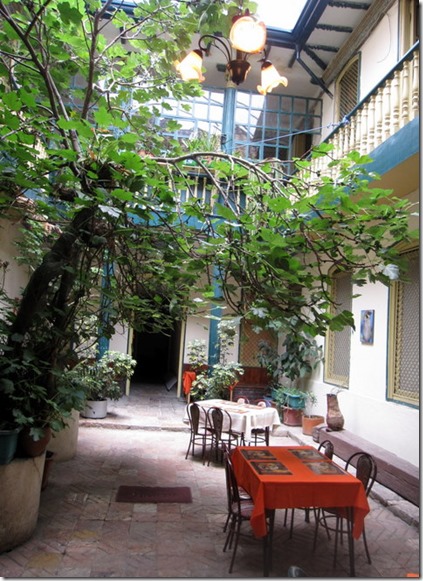
This is a little cafe in the old part of town.  One of the Ecuadorian sisters in our congregation works there.  Many of the old buildings are like this - lovely courtyards on the inside.  You wouldn’t know it from the street.

Some who choose to come to Cuenca go straight to a Spanish-speaking congregation even if they have little or no Spanish. One young sister said that she chose to do that as she needs the challenge to motivate her. Others who have done that have found it’s just too hard for them that way, and have come over to the English congregation for either a short or a long time. It’s probably especially difficult for ones who come on their own without a spouse, friend or family, and without much language and choose to go straight into a foreign-language field, as the isolation is more extreme for them – how do you communicate if you can’t speak the language? How do you ask about the culture or ask for help? How do you have conversations, companionship, make friends, etc?

Some choose to start off in the English congregation and as they acquire more Spanish, go over to a Spanish-language congregation. I guess the trick is to be realistic about what you need to do personally – not necessarily what someone else says or does.

As to learning the language; obviously the more language you have when you come, the easier it will be. We found, here in Cuenca, that you can get by more or less as you pick up the language. We found that the first words we picked up were names of food (essential for shopping and eating) and words that would help us to procure such, as well as the names of different types of shops and businesses that we saw continually from the bus.

1-IMG_5889

                                                  And this wheelbarrow was “just right”

One thing that is difficult and frustrating when you don’t speak the native language is that in many ways you lose your independence, because you can’t communicate freely. Simple things that you take for granted in your home country, such as making a phone call to organise something (for example, a taxi, doctor’s appointment etc) become a big deal. And you either put off doing it, or have to ask long-suffering friends in the congregation who speak better Spanish than you, to help you out.

For instance, we both need to get new glasses. Now something as important as that, we don’t want to take pot luck on, so we plan to take a long-suffering friend who speaks good Spanish with us, but our long-suffering friends also have their own lives to lead, and their own appointments to attend to, and we don’t want to wear out our welcome.

Straightforward things are not too hard to organise, as we look on Google translate and work out which words we need (such as when shopping for furniture – we learned the words for bed, mattress, table, etc) and by pointing and writing down prices etc you get by. And there’s a fair amount of hoping for the best as well. And there are a few Ecuadorians who speak varying amounts of English, so mostly it works out somehow or other.

We’ve found that we can work out in advance what questions we need to ask, and we hope to just get a Yes or a No answer and no other chit-chat, because anything other than that, that’s when we start to have problems. Coz the people you talk to don’t know that other than the words you have studied that morning before you came into their shop, you don’t know anything, and so when you ask them the question or two that you have worked out ahead of time, they go ahead and give you the answers, generally at a fast and incomprehensible rate.
1-IMG_5571

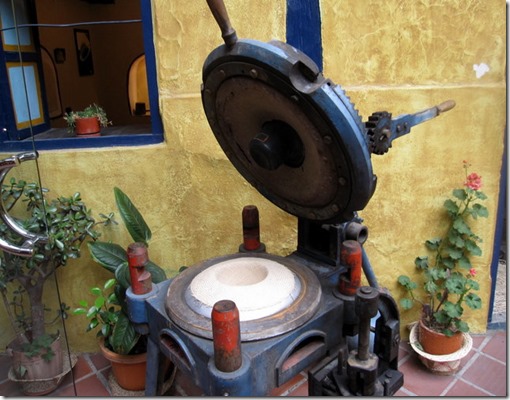
                  Toasted sandwich, anyone?  Funny – it tastes rather like a straw hat!!

It can be difficult not to get discouraged about learning the language, especially when others come along who’ve been here less time than us and who either have better language skills (many from the U.S. have frequent exposure to the language and many speak varying degrees of Spanish) or seem to pick it up more quickly. But we’ve come to realise that everybody learns differently and at different speeds, and you just have to do your own thing and now and then remind yourself of how you have progressed and how much more we understand than when we first arrived here. Also with language, there are so many different learning methods that it can take a while to sort out which way is going to suit you personally.

But as long as we continue making some progress, then that’s good. We are happy that we are progressing.
 

1-IMGP0205

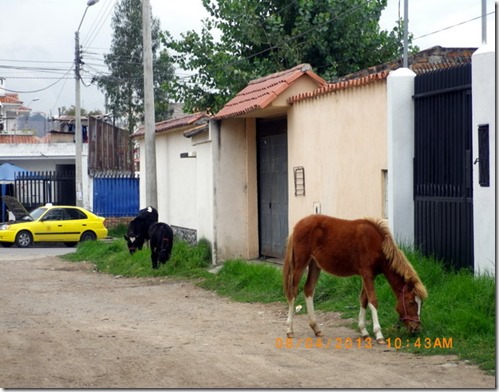
This is our little street (our house is on the right and behind the camera).  This illustrates a rather handy way of solving two problems at once.  Problem 1:  nobody cuts or mows the grass in our little street.  On the paved streets, city workers come through regularly and cut the grass outside the front fences with brush cutters (lawn mowers are very rare here), but it would seem that for some reason we continually miss out on the grass cutting.  Problem 2:  hungry beasties.  Solution?  Park the hungry beasties where there is long grass, tie their ropes to the electricity poles, come back later, and both problems are solved at once!

Before we left Australia, we were talking about writing a blog once we got here, and one sister said that we should write about the bad times as well as the good times. Well, I haven’t really done that so far, but now I shall write about some of the difficult things.

Firstly, Brendan has had less difficulty coping than I have. I know, because I specifically asked him when thinking about writing about this subject.

Sometimes different ones of the brothers and sisters will ask one another, “Do you ever get homesick?” Apart from not being quite sure exactly what that entails, I would have to say that it can indeed be difficult living in an unfamiliar culture with an unfamiliar language.

I know when we were first here, I would look at the houses, the people, the shops, the buses, etc and it was all exciting and interesting and like being on holiday. But when you’ve been here for a while, it’s more like, “I live here now – and it’s all different and unfamiliar”. There are times you don’t want exciting and interesting or different and unfamiliar, you just want familiar and predictable and not having to think about it all too much. Like knowing how to go about doing all the usual things you did back home and knowing the procedures and where to go for this or that and being able to communicate like a grown up rather than a 2-year old.

Also, living in a city is not my favourite thing – I didn’t like cities when we were in Australia and I still don’t. I miss having a garden and I miss having grass and trees around me. There is a lot of concrete in Cuenca, but at least with Cuenca being in a valley, you can often see the hills and trees surrounding it, and that helps.
1-IMGP0220

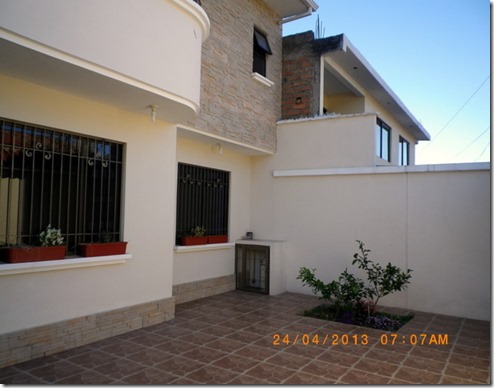
This is our front “garden”.  Two little lemon trees and some flowers in the ground, and some rather sad planter boxes on the window sills.  They are not very happy there.

1-IMGP0221

Oh no, some weeds!  Well, that should take me all of 2 minutes to tidy that up!

1-IMGP0222

Our little backyard. 

We have thought about whether we’ll stay in Cuenca long term or whether we may go to the country at some stage in the future. There are various factors that come into it, the first being that until our Spanish is good enough that we feel we can cope with a minimum of outside help; we figure it makes sense to stay put here. And also in Ecuador, the further you go out into the country away from cities, the facilities, services and standards of living decrease, so we would have to investigate that fully, too. Country towns here, and what they offer, are not like country towns in Australia which are basically a smaller version of cities, and have the usual supermarkets, doctors, etc. And the public transport in country areas is less reliable, scarce or non-existent, too, which matters when you don’t have a car. So we’ll keep our options open in that respect and see what happens.
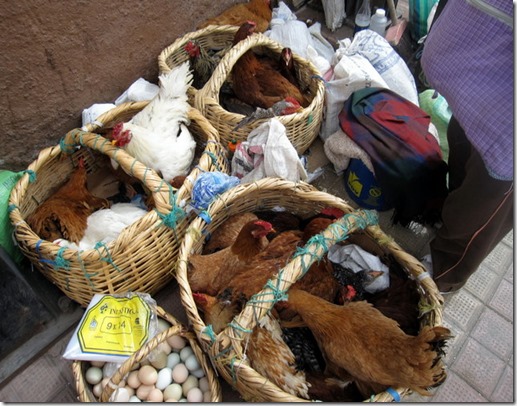
 

1-IMG_5898

                                                         Chicken, anyone?

Some people have said, “Why go to a foreign country and serve in an English-speaking congregation?” Especially if all the “action” is in the foreign field, rather than the English-speaking. Well, wherever you go everyone deserves a witness, especially in their native language if at all possible. Currently in Cuenca there are about four thousand native-English-speakers, and apparently the mayor of Cuenca was quoted as saying that within the next 5 years there could be up to 50,000 English-speakers move into the city, so it’s a continually growing territory and there is a need for these ones to be reached, just as much as the Spanish-speakers.

Interestingly, the supermarket where we shop (frequented mostly by Ecuadorians and some foreigners) has just announced that those of their staff that speak English will now wear badges/buttons that say they speak English, and they have hired a staff member who speaks English and Spanish to help out with any issues that foreigners have.  I know we could have used his assistance a couple of times in the past!
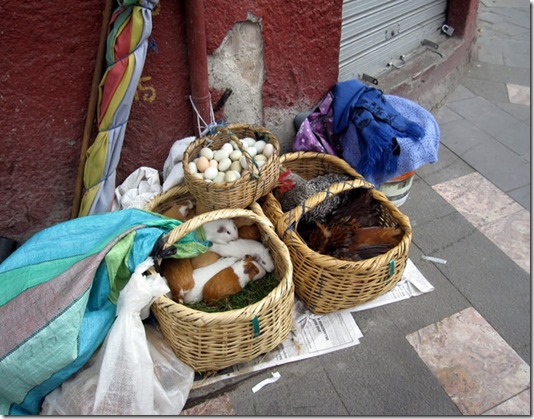
 

1-IMG_5901

                                      Not exactly supermarket shopping!

In the city of Cuenca at the moment, most Spanish-speaking congregations cover their territories every 2 or 3 weeks, although many people are not-at-home. One sister who served in a Spanish-speaking congregation said that due to her limited Spanish (even after 2 or 3 years of being here), she would meet people who spoke Spanish, develop their interest in the Bible, start a Bible study with them, but then would then feel the need to hand them over to a fluent Spanish-speaker so that the student could benefit the most, which was a little hard on her, after her hard work to get them to that point. But for the benefit of the student, she felt that was best.
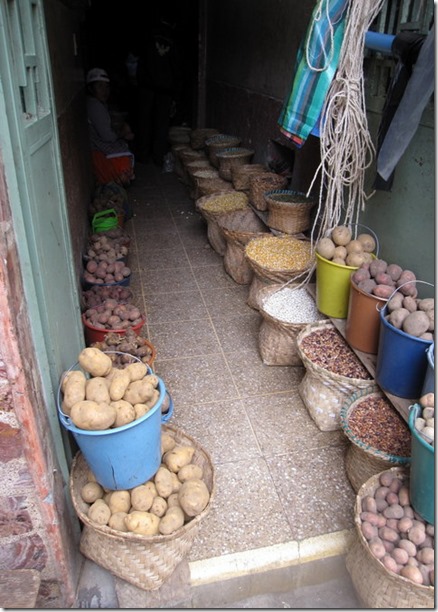
 

1-IMG_5532

In the old part of town, there are many alleys, etc like this where people sell their wares

Another thing some have found who moved into a Spanish-speaking congregation with limited Spanish was that it took quite a while before they could contribute as much as they would have liked to. Even with “basic” Spanish, you soon realise that it’s not enough and that it could take years to develop fluency in the language. Some brothers and sisters of around our age who have been here 2, 3 or 4 years, say that they still don’t pick up all of a conversation in Spanish – depending, of course, on accents, mumbling, how fast the speaker talks, etc. You don’t tend to realise how complex language is, and the importance of communication etc, until you go somewhere where communicating clearly and easily becomes an everyday challenge.

And picking up the language seems to be especially difficult if you are not in your 20’s (or even 30’s!) anymore, like us. Young ones, in their 20’s, for instance, seem to pick up the language without really trying too hard. But after talking to quite a few brothers and sisters around our age group who are trying to learn Spanish, it’s a common story that it can be a struggle if your brain is not so young and fresh anymore.

1-IMG_5587

Inside one of the old buildings in town – this one has been restored. Some of them are pretty amazing!

But, as long as we are making some progress, we figure we will get there in the end, enjoy the journey as we go, and take advantage of the opportunity to be able to serve Jehovah more fully.